
St. Pete Location
Bradenton Location
Save your Spot for My Skin St Pete's
BOO-tox Party | October 23
Patient Education
We're passionate about helping people achieve their healthiest, happiest skin. Whether you're struggling with acne, eczema, rosacea, or any other skin concern, we're here to offer support, information, and inspiration.
How Often Should Florida Residents Get Skin Cancer Screenings?
How Often Should Florida Residents Get Skin Cancer Screenings?
Quick answer: Most Florida residents should get a professional full-body skin cancer screening at least once a year. If you have fair skin, a personal or family history of skin cancer, many moles, a history of blistering sunburns, or spend significant time outdoors, your provider may recommend screenings every 6 months. Florida's year-round UV exposure makes annual screening a baseline, not a maximum, for most adults living here.
Florida's nickname is well-earned, and that's exactly what makes it a higher-risk state for skin cancer. Florida ranks among the top states in the country for UV radiation-linked melanoma, and residents of St. Petersburg and Bradenton are exposed to strong UV levels for most of the year — not just during the summer months. That combination of year-round sun and an outdoor lifestyle is why screening recommendations for Florida residents tend to run more frequent than national averages.
Why Florida Sun Exposure Is Different
A study reported by Moffitt Cancer Center found Florida has among the highest total number of UV radiation-linked melanoma cases of any U.S. state, trailing only Hawaii. A few reasons Florida stands apart:
Year-round UV exposure. Florida's latitude means strong sun exposure isn't limited to summer — many parts of the state see a high UV index for the majority of the year.
Outdoor lifestyle. Warm weather means more time at the beach, on the water, and outdoors overall, which adds up to greater cumulative UV exposure over a lifetime.
Reflected UV exposure. Sand, water, and concrete all reflect UV rays, increasing exposure even on cloudy days or when you're in the shade.
A large retiree and long-term resident population. Skin cancer risk is cumulative, so decades of Florida sun exposure — including sun damage from earlier in life or from time spent in other sunny states — adds to lifetime risk.
General Screening Guidelines for Florida Residents
Average risk: A professional full-body skin exam once a year, along with monthly self-checks at home between visits.
Elevated risk: A professional exam every 6 months if you fall into one or more higher-risk categories (see below).
New or changing spot: Don't wait for your next scheduled screening — any new, changing, bleeding, or non-healing spot should be evaluated promptly, regardless of when your last exam was.
You can see exactly what a professional exam covers, including the ABCDE warning signs providers look for in moles, on My Skin's full body skin cancer exam page.
Who Should Be Screened Every 6 Months Instead of Annually
Certain factors raise your personal skin cancer risk enough that twice-yearly screening is often recommended:
A personal history of any skin cancer, including basal cell, squamous cell, or melanoma
A family history of melanoma
Fair skin, light eyes, or a tendency to burn rather than tan
A large number of moles (50+) or atypical/dysplastic moles
A history of blistering sunburns, especially before age 18
A history of indoor tanning bed use
A weakened immune system, including from certain medications or medical conditions
An outdoor occupation or lifestyle — lifeguards, landscapers, boaters, golfers, and construction workers among them
If any of these apply to you, it's worth discussing a personalized screening schedule at your next visit. My Skin's skin cancer examination page covers what a comprehensive exam involves and why regular screening matters most for higher-risk patients.
What Happens During a Screening at My Skin
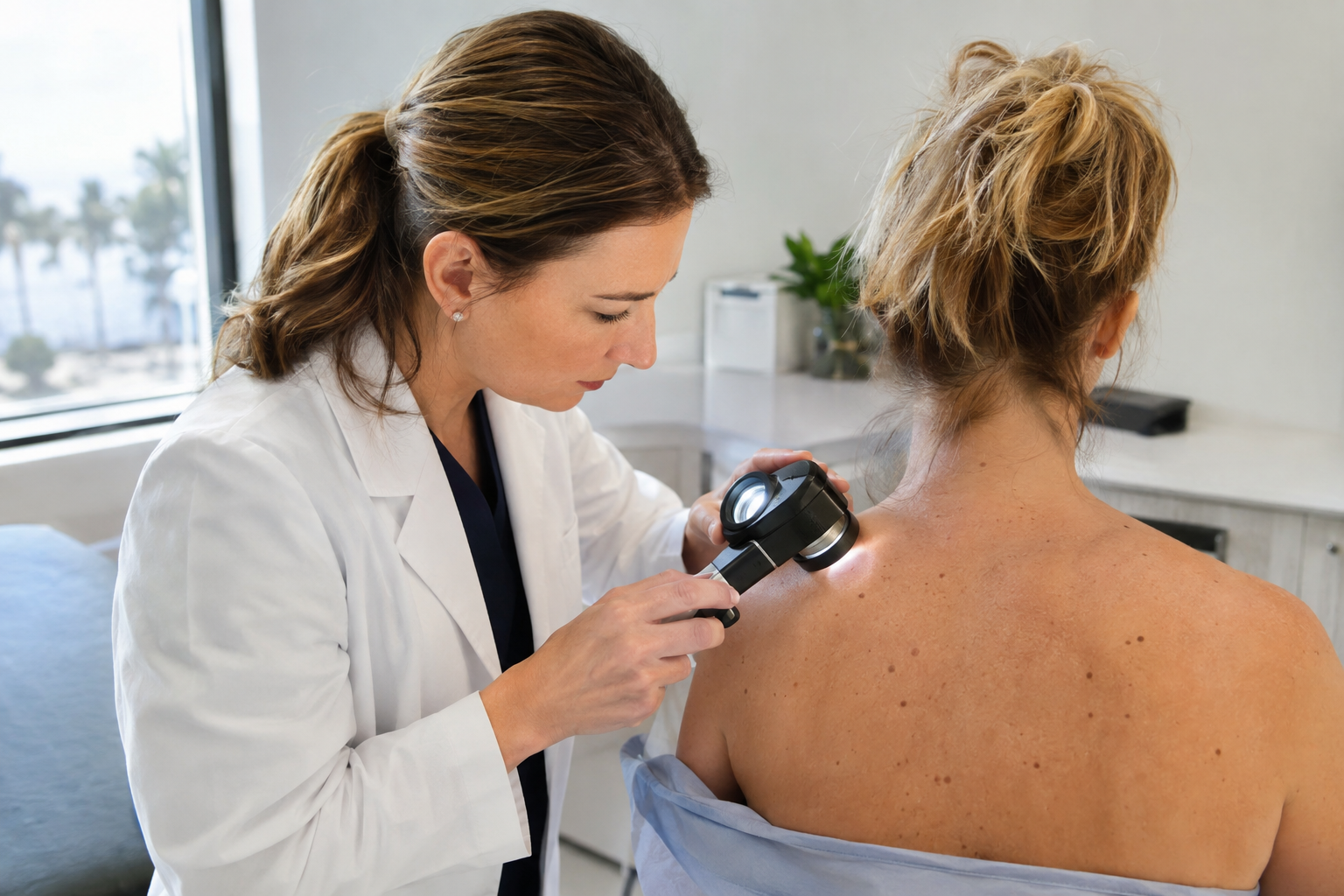
A full-body skin exam at My Skin is a visual, head-to-toe check performed by a trained dermatology provider, covering areas patients often miss on self-exams — the scalp, behind the ears, the back, and even the soles of the feet. Your provider evaluates any spots of concern using the ABCDE criteria (Asymmetry, Border irregularity, Color variation, Diameter, and Evolving), and can perform an in-office biopsy the same day if a spot needs further evaluation.
Leah Michel, APRN, FNP-BC brings 9 years of dermatology experience to every screening, with particular attention to catching subtle warning signs early — including atypical presentations that can be easy to miss. Some skin cancers can even mimic ordinary blemishes; My Skin's guide on whether skin cancer can look like a pimple walks through what separates the two.
Frequently Asked Questions
How often should I get a skin cancer screening in Florida?
Most Florida residents should have a professional full-body skin exam once a year. Those with elevated risk factors — fair skin, many moles, a personal or family history of skin cancer, or significant outdoor sun exposure — are often advised to be screened every 6 months instead.
Why does Florida have a higher skin cancer risk than other states?
Florida's latitude and climate mean residents are exposed to strong UV radiation for most of the year, not just in summer. Combined with an outdoor lifestyle and UV reflection off sand and water, this makes cumulative sun exposure higher for long-term Florida residents than in many other states.
Can I just do self-exams instead of seeing a dermatology provider?
Self-exams are a helpful habit between visits and can help you notice changes early, but they aren't a substitute for a professional exam. Providers are trained to spot subtle warning signs, use tools like dermatoscopy, and check hard-to-see areas such as the scalp and back.
Does insurance cover skin cancer screenings?
My Skin accepts Medicare and most major commercial insurance plans for medical and surgical dermatology visits, including skin cancer screenings. No referral is needed to schedule.
What if I notice a new spot before my next scheduled screening?
Don't wait for your annual or 6-month appointment. Any new, changing, bleeding, or non-healing spot should be evaluated as soon as possible, since early detection significantly improves treatment outcomes.
Living in Florida Means Your Skin Works Overtime — Give It an Annual Check.
Leah Michel, APRN, FNP-BC provides comprehensive full-body skin cancer screenings at My Skin St Pete and My Skin Bradenton, with same-day biopsies available when needed.
Book Your Skin Cancer Screening at myskinstpete.com/book-dermatology-appointment
St. Petersburg: (727) 295-7223 | Bradenton: (941) 330-5805
This blog is for educational purposes only and is not a substitute for professional medical advice. Screening frequency should be personalized with your provider based on your individual risk factors.

If you have any questions or concerns about your skin & would like to schedule an appointment at our St. Pete dermatology office or Brandenton dermatology office, please call us today!
St. Pete Location
111 2nd Ave NE., Suite 1406
St Petersburg, FL 33701
Plaza Tower- Downtown St Pete
Phone: (727) 295-7223
Bradenton Location



Mail
Facebook
LinkedIn
X