
St. Pete Location
Bradenton Location
Save your Spot for My Skin St Pete's
BOO-tox Party | October 23
Patient Education
We're passionate about helping people achieve their healthiest, happiest skin. Whether you're struggling with acne, eczema, rosacea, or any other skin concern, we're here to offer support, information, and inspiration.
HRT and Hair Loss: Can Hormone Therapy Help Thinning Hair?
HRT and Hair Loss: Can Hormone Therapy Help Thinning Hair?
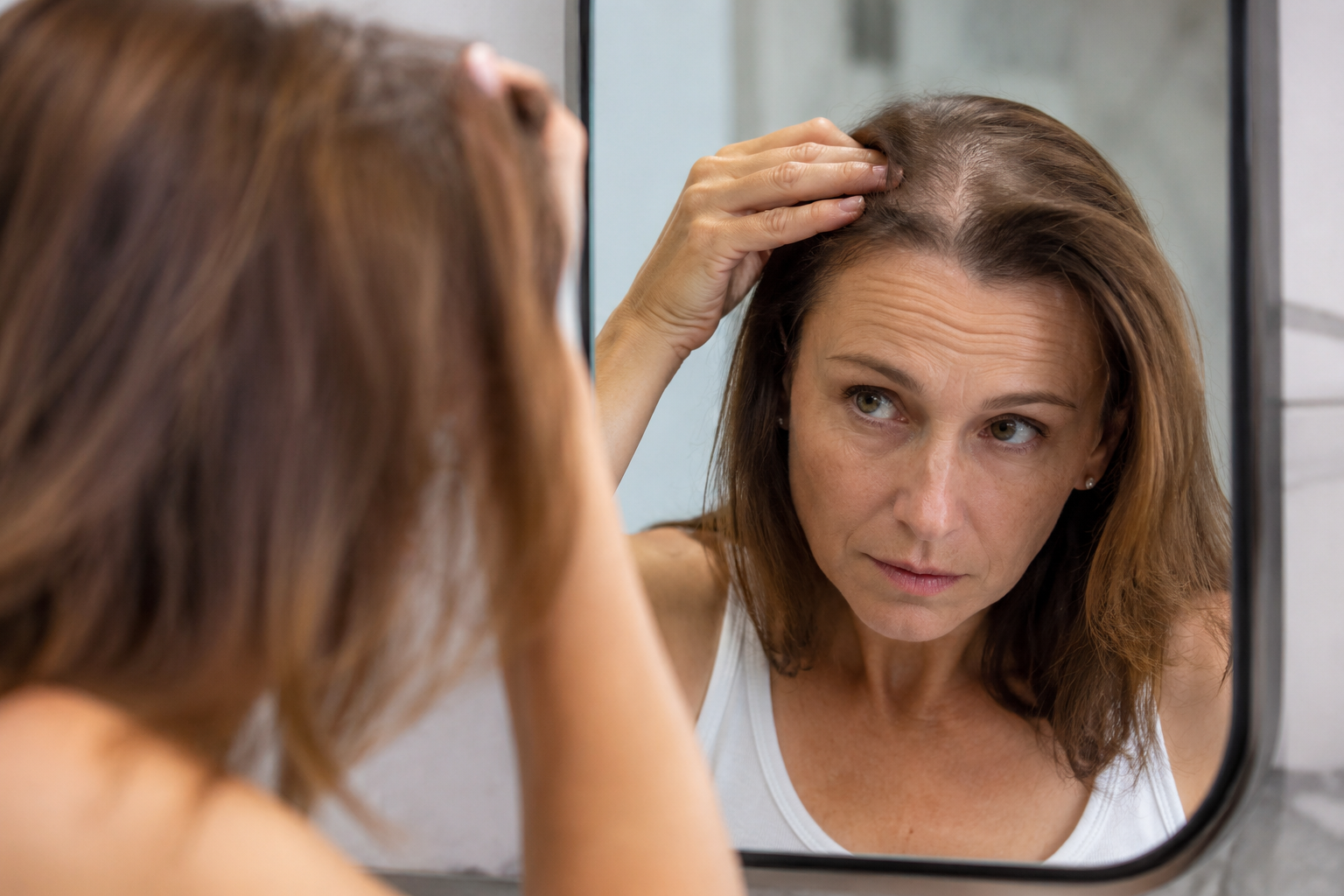
Quick answer: Hormonal changes — particularly declining estrogen during perimenopause and menopause, and declining testosterone during andropause — are a common, often overlooked contributor to hair thinning. Bioidentical hormone replacement therapy (BHRT) may help address this underlying hormonal imbalance for some patients, but hair loss can also stem from thyroid issues, nutritional deficiencies, stress, or genetics. My Skin also offers targeted hair support treatments — including PRP, Plated Hair Serum, and Xtressé Hair Growth Gummies — that can be used alongside or independently of hormone therapy, depending on what's driving your hair loss.
Thinning hair is one of the more emotionally frustrating symptoms of hormonal change, and it's also one of the most misunderstood. Patients often don't connect it to perimenopause, menopause, or declining testosterone until a provider walks them through what's actually happening at the hormonal level. If you've noticed more hair in the shower drain or a widening part line alongside other changes — fatigue, mood swings, irregular cycles, weight changes — hormones are worth investigating.
How Hormones Affect Hair Growth
Hair follicles are sensitive to hormonal signals, which is why hair changes so often track with major hormonal shifts:
Estrogen helps keep hair in its active growth phase longer. As estrogen declines during perimenopause and menopause, more hair follicles shift into the resting and shedding phase at once, which can show up as diffuse thinning.
Testosterone and DHT (a byproduct of testosterone) can miniaturize hair follicles over time in people genetically sensitive to it — a process that can accelerate as hormone levels shift with age in both men and women.
Thyroid hormones also play a major role in the hair growth cycle, which is why a full hormonal picture, not just estrogen or testosterone, matters when hair thinning is the concern.
Hormonal Life Stages Linked to Hair Thinning
Perimenopause and menopause: Fluctuating and then declining estrogen and progesterone can lead to noticeable diffuse thinning, often alongside other symptoms like hot flashes, sleep disruption, and mood changes.
Andropause (age-related low testosterone in men): Shifting hormone levels can contribute to hair thinning alongside fatigue, reduced muscle mass, and mood changes.
Postpartum hormonal shifts: A sharp drop in estrogen after childbirth commonly triggers temporary shedding, though this is typically distinct from longer-term hormonal hair thinning.
Can BHRT Help With Hair Loss?
Bioidentical hormone replacement therapy (BHRT) uses plant-derived hormones structurally identical to what your body naturally produces, and is used at My Skin primarily to address broader symptoms of hormonal imbalance — fatigue, mood swings, weight changes, and low libido — during perimenopause, menopause, and andropause. For some patients, restoring hormonal balance can also improve hair thinning that's directly tied to that imbalance. That said, research on BHRT's long-term effectiveness specifically for hair regrowth is still developing, and it works best as part of addressing the whole hormonal picture rather than as a stand-alone hair treatment.
You can read more about how BHRT works and what it treats on My Skin's bioidentical hormone therapy page.
Other Hair Loss Treatments Available at My Skin
Hormones are only one piece of the picture, which is why My Skin offers several targeted hair treatments that can be used alongside BHRT or on their own, depending on what's driving your hair loss:
PRP (Platelet-Rich Plasma). PRP uses growth factors concentrated from your own blood, injected into the scalp to help stimulate hair follicle activity. It's most often used for pattern thinning and works best as part of a series of sessions rather than a single treatment.
(Plated)™ Hair Serum. A topical serum built on platelet-derived Renewosome™ technology, designed to support fuller, stronger, thicker-looking hair as part of a daily hair care routine.
Xtressé™ Hair Growth Gummies. A daily supplement formulated to support hair follicle health from the inside, often used to complement in-office treatments like PRP or topical serums.
You can see (Plated) Hair Serum and Xtressé Hair Growth Gummies, along with My Skin's other retail skin and hair products, on the skin care products page. PRP and other in-office hair treatments are offered as part of My Skin's cosmetic dermatology services — ask about it during your consultation to see whether it fits your specific hair loss pattern.
Because these treatments work through different mechanisms — hormonal balance, growth factor stimulation, and follicle support — combining more than one is often more effective than relying on a single approach, especially when hair thinning has more than one contributing cause.
Other Causes of Hair Loss Worth Ruling Out
Because hair thinning has several possible causes, an accurate diagnosis matters before assuming hormones are the culprit:
Thyroid dysfunction (both hypothyroidism and hyperthyroidism)
Iron deficiency or other nutritional gaps
Telogen effluvium (temporary shedding triggered by stress, illness, surgery, or rapid weight change)
Genetic pattern hair loss (androgenetic alopecia)
Certain medications
Autoimmune conditions affecting the scalp or hair follicles
What a Hormone Evaluation at My Skin Involves
Before recommending BHRT for any concern, including hair thinning, evaluation typically includes a review of symptoms, medical history, and hormone lab testing to identify what's actually out of balance. This allows treatment to be tailored to your specific hormone levels rather than a generalized approach.
BHRT is offered as part of My Skin's broader cosmetic and wellness dermatology services. Because compounded BHRT is customized to individual hormone needs, it's typically self-pay rather than insurance-billed — you can find more detail on cost and coverage on My Skin's insurance and cosmetic procedures guide.
Leah Michel, APRN, FNP-BC takes a comprehensive, evidence-based approach to hormonal health rather than a one-size-fits-all prescription. Her guidance for patients noticing hair thinning: don't assume it's "just hormones" or "just aging" without a proper workup. Getting a clear picture of what's actually driving the change is what allows treatment — whether that's BHRT, addressing a thyroid or nutritional issue, or a dermatology-focused treatment plan — to actually target the right cause.
Frequently Asked Questions
Does hormone replacement therapy help with hair loss?
It can help for some patients, particularly when hair thinning is directly related to declining estrogen or testosterone during perimenopause, menopause, or andropause. However, hair loss can also stem from thyroid problems, nutritional deficiencies, or genetics, so BHRT works best as part of a broader treatment plan built around an accurate diagnosis, not as a first-line hair treatment on its own.
Can menopause cause hair thinning?
Yes. Declining estrogen during perimenopause and menopause can push more hair follicles into their resting and shedding phase at once, which often shows up as diffuse thinning or a widening part.
How long does it take to see results from BHRT?
Timelines vary by individual and by which symptoms are being treated. Because BHRT addresses an underlying hormonal imbalance rather than acting directly on hair follicles, any improvement in hair thinning tends to be gradual and is best evaluated alongside your other symptoms over several months.
Is BHRT covered by insurance?
Compounded BHRT, customized to individual hormone needs, is typically not covered by insurance and is billed as self-pay. Some FDA-approved hormone therapy formulations may have partial coverage depending on your specific plan and diagnosis.
Should I see a dermatologist or get hormone testing for hair loss?
Often both are useful. Hormone testing can identify whether an imbalance is contributing to hair thinning, while a dermatology evaluation can rule out scalp conditions, autoimmune causes, or genetic pattern hair loss. A provider who can assess both, like Leah Michel at My Skin, can help determine the most likely cause before recommending treatment.
What other hair loss treatments does My Skin offer besides BHRT?
My Skin offers PRP (platelet-rich plasma) scalp treatments to stimulate hair follicle activity, (Plated) Hair Serum for daily topical support, and Xtressé Hair Growth Gummies as a daily supplement. These can be used on their own or combined with BHRT, depending on what's contributing to your hair thinning.
Get to the Root Cause of Your Hair Thinning
Leah Michel, APRN, FNP-BC offers comprehensive hormone evaluations and Bioidentical Hormone Replacement Therapy at My Skin's St. Petersburg and Bradenton locations, tailored to your individual hormone levels and health history.
Book Your Hormone Consultation at myskinstpete.com/book-dermatology-appointment
St. Petersburg: (727) 295-7223 | Bradenton: (941) 330-5805
This blog is for educational purposes only and is not a substitute for professional medical advice. Hair loss has many possible causes — always consult a licensed medical provider for an individualized evaluation and treatment plan.

If you have any questions or concerns about your skin & would like to schedule an appointment at our St. Pete dermatology office or Brandenton dermatology office, please call us today!
St. Pete Location
111 2nd Ave NE., Suite 1406
St Petersburg, FL 33701
Plaza Tower- Downtown St Pete
Phone: (727) 295-7223
Bradenton Location



Mail
Facebook
LinkedIn
X