
St. Pete Location
Bradenton Location
Patient Education
We're passionate about helping people achieve their healthiest, happiest skin. Whether you're struggling with acne, eczema, rosacea, or any other skin concern, we're here to offer support, information, and inspiration.
Male Pattern Baldness: Causes and Treatments | My Skin
Male Pattern Baldness: Causes and Treatments Available at My Skin
Quick answer: Male pattern baldness, also called androgenetic alopecia, is the most common type of hair loss in men. It's driven by genetics and a hormone called DHT, and it usually shows up as a receding hairline and thinning at the crown. It's progressive, so earlier treatment tends to work better. At My Skin, treatment options include PRP, (Plated) Hair Serum, and Xtresse Hair Growth Gummies, along with a personal evaluation by Leah Michel, APRN, FNP-BC.
If you've noticed more scalp in the mirror lately, or your barber has started tactfully changing the subject, you're not imagining it, and you're certainly not alone. Hair loss is one of the most common reasons men start looking into skin and hair care. The good news is that there's more you can do about it today than there was even a few years ago, especially if you act early.
What Is Male Pattern Baldness?
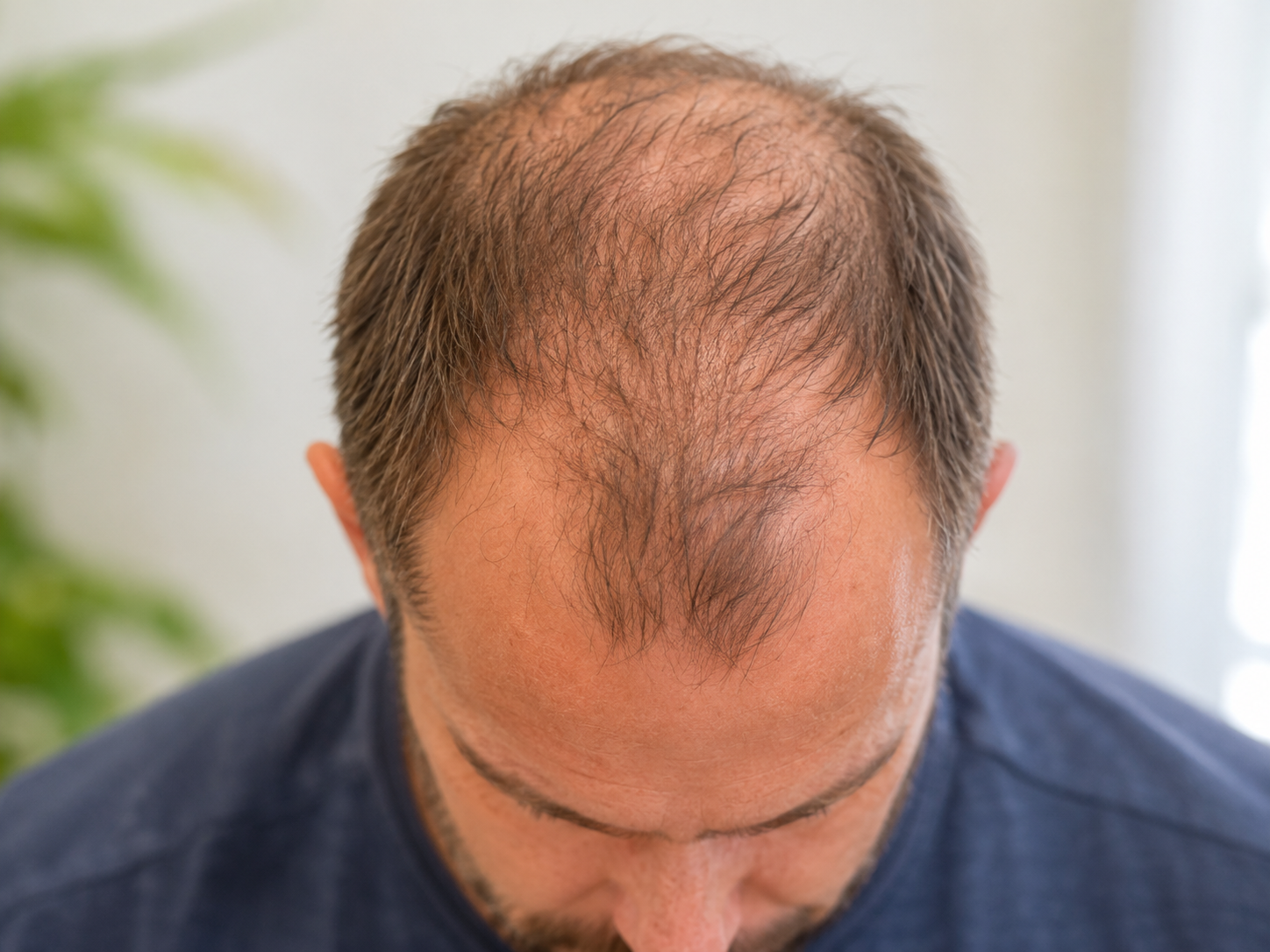
Male pattern baldness is a form of androgenetic alopecia. According to the International Society of Hair Restoration Surgery, it can affect up to 50 percent of men by age 50 and up to 80 percent by age 80. It typically begins at the front hairline and crown, where thick hairs gradually become thinner and shorter over time. In advanced cases, the sides can be affected too.
What Causes It?
Genetics. Pattern hair loss runs in families, though family history isn't always a perfect predictor.
DHT sensitivity. Dihydrotestosterone, a hormone made from testosterone, can shrink sensitive hair follicles over time until they produce finer, shorter hairs, or stop producing them altogether.
Age. The longer the process goes on, the more noticeable it becomes.
Stress, poor sleep, nutrition gaps, medications, and other health issues can also affect hair, which is another reason a proper evaluation is worth it. Not all hair loss is pattern baldness.
Early Signs to Watch For
A hairline that's slowly moving back, often at the temples (an M shape)
Thinning or a widening spot at the crown
Hair that looks finer, shorter, or less dense than it used to
More hair in the shower drain or on your brush
For a deeper medical breakdown of causes, symptoms, and diagnosis, take a look at My Skin's guide to male pattern alopecia.
Why It Pays to Act Early
Male pattern baldness is progressive, meaning it doesn't stop on its own. The ISHRS notes that medical therapy is far more effective in early cases, before full baldness sets in. Follicles that are thinning can often be supported. Follicles that are completely gone are much harder to bring back. That's the main reason not to wait it out.
Hair Loss Treatments Offered at My Skin
Hair loss isn't one size fits all, so treatment at My Skin starts with figuring out what's actually behind yours. From there, Leah can recommend one option or combine several.
PRP (Platelet-Rich Plasma). PRP uses growth factors concentrated from your own blood, applied to the scalp to help support hair follicle activity. It's typically done as a series of treatments spaced about a month apart, with results building gradually over several months. Learn more on My Skin's PRP page.
(Plated) Hair Serum. A topical serum built around platelet derived Renewosome technology, used at home to support the scalp and hair between in office visits.
Xtresse Hair Growth Gummies. A daily supplement formulated to support healthy hair from the inside.
Medical options, when appropriate. Depending on your history, Leah can also talk through other evidence based options, like topical minoxidil or prescription medication, which are the two FDA approved medical therapies for pattern hair loss.
None of these are a guaranteed fix, and results vary from person to person. What they offer is a real chance to slow things down, strengthen what you have, and in many cases improve density, especially when started before the hair loss is advanced.
What to Expect at Your Visit
Leah will look at your scalp and hairline, ask about your family history, how long you've noticed changes, your overall health, and anything you've already tried. She'll explain what she thinks is going on, go over which treatments make sense for you, and what a realistic timeline looks like. If something other than pattern baldness could be involved, she'll tell you that too. There's no pressure and no judgment, just a clear plan.
Frequently Asked Questions
What causes male pattern baldness?
It's mainly caused by a combination of genetics and sensitivity to DHT, a hormone derived from testosterone, which gradually shrinks hair follicles in areas like the hairline and crown.
Can male pattern baldness be reversed?
It can't be cured, but it can often be slowed, and in some cases hair density can improve with treatment. Results are usually better when treatment starts early, before follicles are completely lost.
Does PRP work for male pattern baldness?
PRP is used to help stimulate hair follicle activity and is offered at My Skin as a series of treatments. Results vary by person, and it works best as part of a plan matched to your type and stage of hair loss.
How long does it take to see results from hair loss treatment?
Hair grows slowly, so most treatments take months, not weeks. With PRP, results typically build over several months. Consistency matters more than speed.
At what age does male pattern baldness start?
It can begin as early as the late teens or twenties, though it's more common as men get older. Noticing it early gives you more options.
Is hair loss always male pattern baldness?
No. Stress, illness, medications, nutrient issues, and scalp conditions can cause hair loss too. An evaluation helps sort out which one you're dealing with.
Ready to Do Something About Your Hair Loss?
Leah Michel, APRN, FNP-BC will evaluate your hair loss, explain your options, and build a plan that fits you at My Skin's St. Petersburg or Bradenton office.
Book Your Appointment at myskinstpete.com/book-dermatology-appointment
St. Petersburg: (727) 295-7223 | Bradenton: (941) 330-5805
This blog is for educational purposes only and is not a substitute for professional medical advice, diagnosis, or treatment. Individual results vary, and no treatment can guarantee hair regrowth. Always consult a licensed medical provider to determine the right plan for you.
If you have any questions or concerns about your skin & would like to schedule an appointment at our St. Pete dermatology office or Brandenton dermatology office, please call us today!
St. Pete Location
111 2nd Ave NE., Suite 1406
St Petersburg, FL 33701
Plaza Tower- Downtown St Pete
Phone: (727) 295-7223
Bradenton Location



Mail
Facebook
LinkedIn
X