
St. Pete Location
Bradenton Location
Save your Spot for My Skin St Pete's
BOO-tox Party | October 23
Patient Education
We're passionate about helping people achieve their healthiest, happiest skin. Whether you're struggling with acne, eczema, rosacea, or any other skin concern, we're here to offer support, information, and inspiration.
Is That Pimple Actually Skin Cancer? | My Skin Dermatology St. Pete & Bradenton
Is That Stubborn Pimple Actually Skin Cancer? Here's What You Need to Know
You've had that same bump on your face — or maybe your back, your shoulder, your scalp — for weeks now. Maybe even months. You've tried spot treatments, left it alone, picked at it a little (we've all been there). And yet, it's still there.
Here's the thing: a pimple that won't go away might not be a pimple at all. In some cases, what looks like an ordinary blemish can actually be a form of skin cancer. Before you write this off as a worst-case scenario, know that this is one of the most common reasons people end up in our office — and the earlier we catch it, the easier it is to treat.
Let's talk about what to look for, when to worry, and what to do next.
Why Skin Cancer Can Look Exactly Like a Pimple
Most people picture skin cancer as a dark, irregular mole. And while melanoma can look that way, it's far from the only type of skin cancer. In fact, basal cell carcinoma (BCC) — the most common skin cancer in the U.S. — frequently looks like a pearly pink bump, a flesh-colored spot, or even a recurring pimple that never fully heals.
Squamous cell carcinoma (SCC) can also mimic blemishes. It may appear as a rough, scaly patch, a red sore, or a raised lump that looks irritated or inflamed — all things most of us would dismiss as a breakout or ingrown hair.
The difference? Skin cancer doesn't respond to acne treatments. It doesn't come to a head and go away. It sticks around, often slowly growing or changing over time.
The Telltale Signs: Skin Cancer vs. a Regular Pimple
Here's a quick way to tell the difference between a blemish and something that warrants a closer look:
Signs it's probably a pimple:
Appears suddenly, often after stress, hormonal changes, or sweat
Has a visible whitehead, blackhead, or pus
Tender to the touch
Resolves (even if slowly) within a few weeks
Responds to acne treatments
Signs it might be something more:
Has been there for 4+ weeks without improving
Looks shiny, pearly, or waxy — especially on the face, ears, or neck
Bleeds easily or won't fully heal
Has a depressed center or rolled edges
Keeps coming back in the exact same spot
Doesn't hurt at all (many skin cancers are painless)
If any of those second-column signs sound familiar, it's worth getting it checked out. We can't diagnose anything over the internet — but we can take a look in person and give you a real answer.
The Most Common Types of Skin Cancer That Mimic Pimples
Basal Cell Carcinoma (BCC)
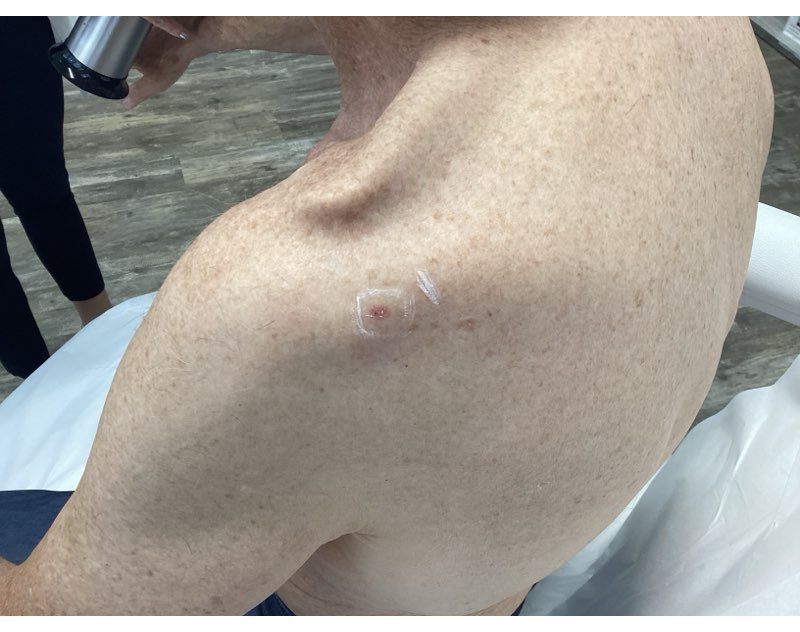
BCC is the most frequently diagnosed skin cancer, and it's also the sneakiest. It often shows up on sun-exposed areas like the face, scalp, ears, and neck as:
A small, pearly or translucent bump
A flat, flesh-colored lesion
A pink growth with slightly raised edges
A sore that heals and reopens repeatedly
BCC rarely spreads to other parts of the body, but it can grow deep into the skin and cause damage if left untreated.
Squamous Cell Carcinoma (SCC)
SCC tends to look rougher than BCC — think scaly patches, crusty bumps, or open sores that don't heal. It often appears on the:
Rim of the ear
Lower lip
Hands and forearms
Scalp (especially in men with thinning hair)
SCC can spread if not caught early, so prompt evaluation is important.
Keratoacanthoma
This one is particularly easy to mistake for a large pimple or cyst. Keratoacanthomas grow quickly — sometimes over a few weeks — into a dome-shaped bump with a crater-like center. They usually appear on sun-exposed skin and, while often considered low-grade, still require evaluation and treatment.
Where to Look: Common Spots Skin Cancer Hides
Skin cancer doesn't play favorites. While UV exposure is a major risk factor, it can show up in places that rarely see the sun. Keep an eye on:
Face, nose, and cheeks
Ears and behind the ears
Neck and décolletage
Scalp (especially with hair loss or thinning)
Upper back and shoulders
Arms and backs of hands
Legs (particularly common in women)
Any persistent, unusual bump in these areas deserves a professional look — not a second squeeze and a prayer.
Risk Factors That Make This More Than Just a Pimple Concern
Anyone can develop skin cancer, but certain factors raise your risk:
Fair skin, light eyes, or light hair — less melanin means less natural UV protection
History of sunburns — especially blistering burns in childhood or teen years
Frequent sun exposure or tanning bed use
Family or personal history of skin cancer
Age — though skin cancer is increasing in younger people, too
Weakened immune system
Living in a sunny climate — hello, Florida
If you check several of these boxes and you've got a bump that won't quit, please don't wait on this.
What Happens at a Skin Cancer Check
If you've never had a skin cancer screening, here's what to expect: it's simple, quick, and completely non-invasive.
At My Skin in St. Pete and Bradenton, Leah Michel, APRN, FNP-BC will do a full visual assessment of your skin. She'll note any spots that look unusual and talk you through what she sees. If something needs a closer look, she may recommend a biopsy — which involves taking a tiny skin sample to test in a lab.
This sounds scarier than it is. A biopsy is a minor, in-office procedure, and it's the only way to know for certain what you're dealing with.
We also offer surgical dermatology services right here in our office, so if something does need to be removed, you don't have to go anywhere else.
Don't Wait on This — Early Detection Truly Changes Everything
The survival rate for melanoma caught at its earliest stage is around 99%. For basal cell and squamous cell carcinomas caught early, treatment is typically straightforward and highly effective.
Waiting — especially if you live somewhere like St. Pete or Bradenton where year-round sun exposure is just part of life — is the one thing you don't want to do.
If you've been staring at that same spot for months telling yourself it's nothing, this is your sign to stop guessing and get a real answer.
Ready to Get That Spot Checked?
At My Skin by Leah Michel, we offer skin cancer screenings and spot checks at our St. Petersburg and Bradenton locations — and yes, we accept Medicare and most major commercial insurances for medical dermatology.
Don't spend another month wondering. If something on your skin doesn't look right, it probably deserves a second opinion from someone who actually knows skin.
St. Pete: (727) 295-7223 | Bradenton: (941) 330-5805
Medical Disclaimer: This blog post is for informational purposes only and is not intended to serve as medical advice, diagnosis, or treatment. Always consult a qualified healthcare provider with any questions you may have regarding a medical condition. For personalized care, schedule an appointment with Leah Michel, APRN, FNP-BC at My Skin Dermatology.

If you have any questions or concerns about your skin & would like to schedule an appointment at our St. Pete dermatology office or Brandenton dermatology office, please call us today!
St. Pete Location
111 2nd Ave NE., Suite 1406
St Petersburg, FL 33701
Plaza Tower- Downtown St Pete
Phone: (727) 295-7223
Bradenton Location



Mail
Facebook
LinkedIn
X